 ARTICLE ARCHIVE
dot's in a name?
The internet is running out of domain names, a situation that has serious ramifications for its future administration, writes Angus Kidman.
March 27, 2001
|
Last November, ICANN announced that applications to operate seven new domains, including biz, info, name and pro, had been approved following the whittling down of a pool of more than 184 applicants.
These names were supposed to be operational before an ICANN quarterly board meeting began in Melbourne last week. It didn't happen. A shortage of cash and arguments over the administration of the contracts to issue the new names meant the best the board could do was vote to speed the new contracts through as fast as possible.
So how did the company that essentially runs the internet run out of cash? ICANN's funding is largely based on altruism. The companies and organisations that make profits from selling new domains and managing existing ones make donations to keep it running. Since the new domains weren't approved quickly, the companies that would have issued them haven't been paying their dues. It's a Catch-22: no new domains means no new donations means no new domain names, and it has left ICANN millions of dollars in the red.
At the Melbourne meeting, ICANN Finance committee head Linda Wilson revealed that more than $US2m ($4m) was owed to ICANN by its contributing bodies.
`The process [of approving new domains] has proved to be more difficult than we anticipated," says a representative for NeuLevel, a joint-venture company formed between the Australian domain registrar Melbourne IT and an American communications infrastructure developer, NeuStar, that will run the biz domain.
While approving the applications for new top-level domains is relatively straightforward, one of ICANN's major concerns is that the additions don't undermine the basic stability of the existing internet infrastructure. Ideally, that would require a much larger budget. We are woefully underfunded to actually carry out the mission we have been charged with," says board member Jonathan Cohen. And the longer that the new domains take to approve, the longer it is before ICANN will have any chance of drawing in some cash and fulfilling its functions.
One possible solution to that cash problem looms in a proposed change to the deal between ICANN and VeriSign; the American company that controls registrations for the popular com, .net and org domains. Under a deal it made with the United States government well before ICANN itself was established in 1998, VeriSign will enjoy exclusive control of registrations in all three domains until 2007 and has caps placed on the fees it has to pay to ICANN to exercise those rights.
In early February, a revision was proposed that would see the caps removed, along with VeriSign giving up rights to the .org domain in 2002 and net in 2005. In return, VeriSign would get a pre-emptive right of renewal for the .com space, which accounts for 80% of its registrations.
The proposal caused outrage in the internet community, which resents what is widely considered VeriSign's monopoly on the.com space (other businesses can sell.com domain names, but VeriSign still gets a share of the profits). Much of the anger centred on the timing of the deal. ICANN will hold a board meeting on April 2 to vote on whether to accept the proposal, a period seen as far too short by supporters of ICANN's bottom-up, committee-driven process. VeriSign CEO Stratton Sclavos said at the Melbourne meeting that if the deal didn't go through, there would be no second chance to consider it, and the original deal would remain.
If the new domains aren't approved, many companies may decide to launch their own competing domains without the benefit of strict technical approval. One US company, New.net, has already begun selling 20 non-approved domain names. Because they're not part of the official net infrastructure, sites using those domains may be invisible to many net users, a situation that concerns most observers.
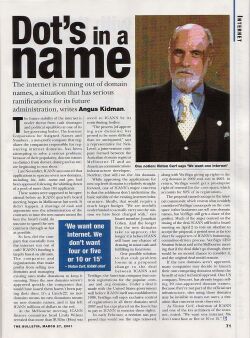
As Vinton Cerf, chairman of ICANN and one of the key architects of the internet, noted: "We want one internet. We don't want four or five or 10 or 15."